COMPLETED
EINSTEIN GENERAL THEORY OF RELATIVITY (CGTR)
Nimit Theeraleekul
B. Eng. (Communication)
(February 28, 2007, 2nd.
revised June 1, 2009)
Abstract: Einstein general
theory of relativity (GTR) has been criticized for their philosophic problems
(both which came from STR and its own problems), despite of their
predictability and accuracy. Indeed all the problems could be eliminated by
using “Vacuum Mechanics” i.e. the mechanism of vacuum medium!
Content: 1) Introduction. 2) Mechanism
of gravity. 2.1) Why do masses attract each other? 2.2) How do masses attract each other? 3) Philosophy behind space-time. 3.1)
Newtonian space-time vs. Minkowskian space-time. 3.2) Vacuum
medium space-time. 4) Physical meaning of space-time
curvature.
4.1) A new view of curved surface. 4.2) A better view of curved space-time. 5) Modification of GTR. 5.1)
Einstein tensor is vacuum tensor.
5.2) Return
of cosmological constant. 6) Solution to some crucial problems. 6.1) Problem with
speed of gravity wave.
6.2) Some others remaining problems. 7) Vacuum medium
universe – a better view of our universe. 7.1
Fulfilling the cosmological principle. 7.2) What is a
hypersphere? 7.3) The origin of universe. 7.4) Our
universe is closed!
8) Conclusion.
9) References.
.
1) Introduction. This article is the third
expanding part of the original article “Vacuum mechanics a New Approach to the
Theory of Everything” (VMTE) [1]. Four most important theories are involved
in VMTE; Maxwell electromagnetic field theory (EMT), Einstein special theory of
relativity (STR), Einstein general theory of relativity (GTR) and Quantum
mechanical theory (QMT). Because what has been talked in VMTE is rather a
philosophical one, so the first two articles have been expanded with the titles
“Completed Maxwell electromagnetic field
theory” (CEMT) and “Completed Einstein special theory of
relativity” (CSTR) respectively
[1]. Here in this paper, GTR will be expanded to “Completed Einstein general theory of relativity” (CGTR) in a
more scientific detail. And because CGTR is related to VMTE and CSTR, so we
have to refer to them quite often in this article, so they are summarized as below.
(For more detail please refers to the reference.)
In VMTE we
have started with the fundamental hypothesis that “Vacuum medium is the fabric structure of vacuum space”. And it was proved that
vacuum space is not the conventional empty vacuum space; instead it is vacuum
medium space! In more detail it is the privileged
absolute reference frame of a
continuous isotopic homogenous medium and having a peculiar mechanical
property; it is very thin in mass density which is permeable by all matters
almost without any observed resistance!
“Electrons and protons are tiny black holes” is the consequence
hypothesis, and they were proved to be the “condense” of vacuum medium. Both of them are the
two elementary particles which form to be all
kinds of the material matters existed in the universe! So our universe is composed of material matters immerge in a
huge volume of vacuum medium.
Vacuum
mechanics – a new conceptual mechanics. It is the mechanism of vacuum medium
i.e. the action of vacuum medium, or of condensed vacuum medium, and the
interaction between them, which is responsible for all natural phenomena in
our universe! Latter we will see how this vacuum mechanics is the key for
solving the philosophic problems in GTR.
For CSTR, we have derived the Lorentz transformation by using vacuum
medium as the privileged reference frame and so we could understand its physical meaning! Then
we have showed that “the increasing mass” of the moving object was
due to the inertial resistance of vacuum medium (not the increasing of the
material mass of the object itself).
And we showed that “time
dilation” of the moving frame was the slowing of the measuring clock’s
mechanism (due to the inertial resistance of vacuum medium) and we have
called it as “relativistic clock”. Also there is no real “length contraction”,
it is a relative length which occurred in STR for trying to keep the constancy
of light velocity referenced to the moving observer! Finally we have shown how
to solve the unsolved problem in classical mechanics (as STR does), but with a
more rational and understandable way.
Now to improve GTR to be CGTR, we will first point out detail of the philosophic problems (i.e.
the idea that showing how it works) of the main parts that involved; the principle
of relativity, space, time, mass and gravity. Next using the new propose concept of vacuum mechanics to solve the
problems. Finally what we got after
modification is a more rational and understandable GTR that is CGTR!
2) Mechanism of gravity.
Sir
Isaac Newton had first provided us with his Universal law of Gravitation via
the formula (1) below, which state that two mass attract each other with the
force F that directly proportional with their masses  and
and
 ,
and inverse proportional to square of the distance r between them.
,
and inverse proportional to square of the distance r between them.
 …. (1),
  …. (2),
  …
(3).
…
(3).
But Newton
said nothing about “why and how masses
attract each other”. So modern physicists try to explain it
via gravitational field concept. And according to the formula (2) that
the gravitational potential  at any point around a source mass M is
direct proportion to the mass over the separate distance r. This seems
to be okay, but why and how? We could not visualize the working process; it is
just an ad hoc solution.
at any point around a source mass M is
direct proportion to the mass over the separate distance r. This seems
to be okay, but why and how? We could not visualize the working process; it is
just an ad hoc solution.
Lastly while Einstein said that gravity is the manifest of
curve space-time according to his famous field equation (3) (where is
Einstein tensor
is
Einstein tensor  is energy-momentum
tensor and k is a coupling constant),
but why and
how mass and energy cause space-time to curve is unexplained! Armed
with the concept of the mechanism of vacuum medium i.e. vacuum mechanics, we are now going to see “why and how masses
attract each other”
together.
is energy-momentum
tensor and k is a coupling constant),
but why and
how mass and energy cause space-time to curve is unexplained! Armed
with the concept of the mechanism of vacuum medium i.e. vacuum mechanics, we are now going to see “why and how masses
attract each other”
together.
2.1) Why do masses attract
each other? As mentioned about VMTE in the first
section that “space was created out of vacuum medium energy” or we could say that
vacuum medium is the fabric structure of vacuum space. And the most important special intrinsic
property of vacuum medium is that
every infinisimal part of them attracts each other with their own intrinsic gravitational
force (contraction force)!
Also in VMTE we have verified that “electrons and protons
are tiny black holes of condensed vacuum energy”. (We could visualize them as two sizes of small solid spheres of
the very concentrated vacuum
energy; electron: a smaller one, proton: a bigger
one). So electron
and proton can attract each other (also with the
surrounding vacuum medium space) with their black hole forces, a much
stronger attractive force than normal gravity (which created by masses attraction).
Actually these black hole forces are the familiar forces known as
electrostatic or Coulomb forces!
Now we knew that all the matters in the universe compose of two elementary charge
particles i.e. electron and proton. And because both of them are tiny black holes of condensed
vacuum medium (which have its intrinsic gravity property), so it is inevitable
that gravity is also the property of material masses. Anyway we have to make
clear that the gravity between masses is different from the gravity
inside masses. All attraction forces between any component parts within mass
are black hole forces, while the attraction forces between masses are normal
gravitational forces!
(Please note that all
size of tiny black holes always attracts each other. There is only one
special case in which the same size (same type of charge) will repel, that is
when both of them closing to each other at a certain distance. This is because of
the repulsive stress in the vacuum medium between them is dominated (please see
detail in VMTE). So from now on when talking about the interaction between
charged particles we will refer only to attractive force, which is the
force between electron and proton!)
Now to see the action of black hole force (or
Coulomb force)
within masses, first we have to start with the most simple atom i.e. hydrogen
atom. We know that it was formed by electron and proton attract close together by black hole force. But notice that both particles are
still not attach together because the existing of vacuum
medium between them. To displace the medium between, some external
additional forces was used. This extra force must be strong enough to tear
off the medium which was called weak force! Next is the nucleus of
helium atom which composes of two protons and two neutrons. From the former
paragraph we could see that two protons will repel each other when they are
closing together enough, but not yet attach together. So some external
additional force must be used to overcome the repelling force, and this
extra force (a short range force) was called as strong force!
Next talking about the
attraction force between atoms within a molecule, and between molecules,
are they also black hole force? Indeed they are; all categories of bonding i.e.
Val der Waals or molecular bonding,
ionic bonding, covalence bonding, metallic bonding and hydrogen bonding all are
electrostatic forces [2] i.e. black hole force! (Please be reminded that mass is not
directly attracted each other but working via
vacuum medium, in which there also has internal attraction force within vacuum
medium itself).
In conclusion, we may say that “any kind of material masses compose
of billions of tiny black holes holding together with black hole force, so
this is the reason why masses attract each other”!
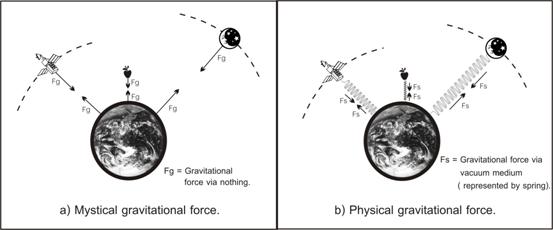
Figure 1 Attraction mechanism between two masses.
Finally, before finding
out “how masses
attract each other” we have to
point out one of the most crucial concept about the action of force, that is “any interaction of forces between two
masses which is not a direct contact action, there must be some kind of mediums acting as a
transmitting mechanism for the force”! For example when we want to pull an
object we must use some material such as rope as the transmission of force. And
even within (or between) atoms of rope’s material we would found that there are
filled with vacuum medium which acting as force transmitter.
Unfortunately in our
daily life, we could not see vacuum medium, while we all are familiar
to gravity, so it seem that no medium is required as in diagram fig.1 (a).
And when we look at diagram1 (b) for the first time, it would look crazy!
But after considering for a second we would found that it was crazier if there is nothing pulling between them. Why?
Because gravity is physics (science of nature) not mystic (unscientific)
and we will return to talk more detail next.
2.2) How do masses attract
each other? When physicists
use gravitational field concept to explain the attraction force between masses,
they are wondered why it is so similar to electrostatic field concept. And they
seem to believe that they are different thing. Armed with the concept of vacuum mechanics, we could understand without difficulty that both fields are the same thing; it is the contraction force field
(internal stress) in vacuum medium!
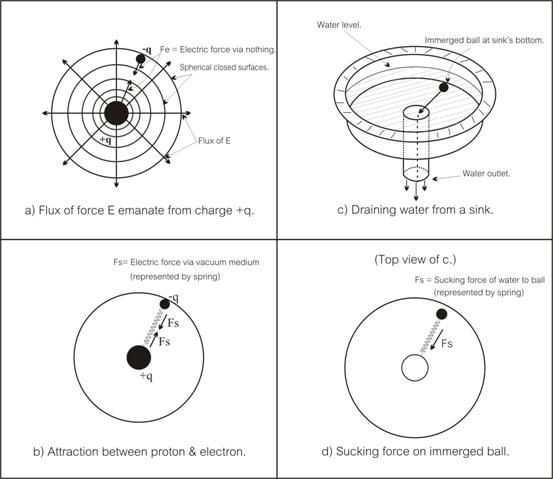
Figure 2 Attraction mechanisms between two charges.
Before seeing “how masses attract each other”, it is easy to start with “how
charges attract each other” by using the idea of “the flux of E (electric
field)” explained by Richard P. Feynman [3].
According to diagram 2(a), flux of E emanate from charge +q (proton) in
a spherical shape (shown in circle) around the charge, and at any distant r from
center of charge,
 ….. (4).
(where
….. (4).
(where  is the permittivity constant).
Actually E is the
force that will act on a unit charge placed anywhere in the electric field E. So the total flux of force from charge +q is as follow.
Total
flux of force through closed
surface = 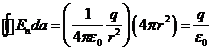 …. (5).
Note,
even “flux” means “flow” but “flux of force” does not mean “flow of force”,
instead it means “emanating of
attractive force” via the internal stress of vacuum medium” around the
charge sphere +q. Or we could say that at a distance r from charge +q,
there is an attractive force (a contraction stress in vacuum medium) per unit
area equal to . And if -q
charge is placed at r, then the attractive force per unit area is equal to
. And if -q
charge is placed at r, then the attractive force per unit area is equal to as showing
as the contraction spring in fig.2 (b).
as showing
as the contraction spring in fig.2 (b).
And
to make it easy to understand “how charges attract each other”, look at
diagram 2(c) and 2(d) for analogous concept. While water is draining from
sink, the tiny ball immersed in water was sucked via water and moving forwards the
drain!
Now
in the similar way, we could calculate the
total flux of force from the normal mass M in fig.1 (a) (Readers could
found the detail in “Gauss’s law for the gravitational field” [8].) as follow.
Total
flux of force through closed
surface = .. (6).
[Where 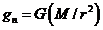 … (7) is the force of the gravitation
field which acts at a unit mass placed at the surface of the sphere with a
radius r and G is the gravitational constant. (g
is the same thing as the acceleration of a unit mass.)]
… (7) is the force of the gravitation
field which acts at a unit mass placed at the surface of the sphere with a
radius r and G is the gravitational constant. (g
is the same thing as the acceleration of a unit mass.)]
To interpret the
meaning of formula (6) we have to look at its unit, which is force . area / mass (newton.meter2 /Kg.). So the formula say that M Kg. of mass creates gravitational force multiply
by the enclosed area is equal to  (newton.meter2) around
the mass sphere via the internal stress of the surrounding vacuum medium.
Or we could say that, at any point r from the mass M there is a
gravitational force act at a unit mass placed there per unit area =
(newton.meter2) around
the mass sphere via the internal stress of the surrounding vacuum medium.
Or we could say that, at any point r from the mass M there is a
gravitational force act at a unit mass placed there per unit area = . And if mass m was placed
at r then the gravitational force between M and m per unit area =
. And if mass m was placed
at r then the gravitational force between M and m per unit area = , which shown as the contraction springs in fig.1 (b).
Now we come back to explain more detail about diagram fig.1
above. For diag.1 (a), when considering it scientifically we would found
that it is mystic. The reason is because there is no mechanism for
gravity (for explain how it work) so it is a supernatural phenomenon!
Instead if we accept that there are infinite numbers of unseen spherical
concentric shells of internal stress in vacuum medium around the earth. Then each shell represents different value of gravitational
force which is the manifest of internal stress in vacuum
medium.
While the closer shells to the earth mean
the stronger of the gravitational force, and the far away shells mean the weaker of the gravitational
force according to formula (7). So if we understand the mechanism which just
explained, then the mystic view of the unseen gravitational force is
not mystery anymore! Anyway,
for someone who is not familiar with the unseen “internal stress in some
material medium” it is still difficult to visualize. So the contraction
spring in diag.1 (b) would give a better view, even though it may look
strange and unfamiliar to us!
Finally we come to the conclusion; in this section we have explained the mechanism of gravity which is the action of the internal stress in vacuum medium between masses. While in the former section we have shown that mass which was formed from billions of tiny black holes (condensed vacuum medium), so it also has gravity as its own property. Then by using the concept of vacuum mechanics, we could say that “masses create gravity and manifest it via the internal stress in vacuum medium”, O K?
3) Philosophy behind space-time. All of us live in the world or actually in the universe that involved with “space” and “time”. Then everything, all natural phenomena and human activities can not be separated
from space and time. Nowadays we have two types of them; the first one is classical
Newtonian space-time and another one is relativistic Minkowskian space-time. Anyway it is interesting to note that both
concepts of space-time still have their own problem until now! So
we have to clarify them first before we could improve and got a complete GTR.
3.1) Newtonian
space-time vs. Minkowskian
space-time.
Let’s start with Newtonian space-time with absolute three dimensions spatial space
and one universal time. It is the same thing as Euclidean space in which the
square of Euclidean “distance” between two adjacent
Cartesian coordinates is

 …… (8).
Note that each spatial
distance term and time interval of (8) is invariant (constant).
But according to STR, where the constancy
of speed of light (referenced to any moving initial observers) was used to link
these three dimensions of space and one dimension of time, and what we got is a
four dimensions space-time called Minkowskian
space-time. And the square of space-time “interval” between two events is
 …… (9).
Note that each spatial
distance and time interval term in the right hand side of (9) is not invariant
(not constant).
Now by comparing
Newtonian space-time with Minkowskian
space-time we would found that in the former, space is absolute
(constant) and independent from time, while in the latter space and time
are dependent. And notice that both of them are the concept of empty
space not physical space. There is a weak point about universal time in
Newtonian space-time; that is the concept of instantaneous action at a distance.
It means that any action of force or traveling of light signal occur with
infinite speed which is unacceptable. But this is what it should be because
it is correspond to Newton’s concept that space is empty! The reason is
that light speed is infinite in any medium with zero density (Wave speed in any
medium is proportion to square root of elasticity over density).
Minkowskian space-time also has a weak
point about the distortion of both space and time; that is there is both the
time dilation and length contraction! The reason is because Einstein
mixed them by keeping “constancy
of speed of light referenced to inertial moving observers” for his derivation of Lorentz transformation (Please see detail in CSTR). Up to now we
have seen the problems which involved with both Newtonian and Minkowskian
space-time. So
what we want now is a better view of space-time
which has no side effect mentioned above; that is “Vacuum medium
space-time”.
3.2) Vacuum medium space-time. Based on “vacuum medium is the fabric structure of
vacuum space”, vacuum medium space is a physical space not an empty one.
It is the
same concept as Newtonian absolute space with universal time; the only difference
is that vacuum medium space is a physical space
not an empty as
Newtonian space do. This means that the distance between any two points in
space is constant, while the
universal time means at any
instant, time is the same and it flows evenly
everywhere. So what was defined as the continuum of four
dimensions space-time, actually
it is the continuum of three spatial spaces at any instant time!
Another thing that vacuum medium space-time different from Newtonian space-time is that speed of any action or speed of light signal is c, not infinity (according to vacuum mechanics, any
disturbance in vacuum medium propagate with light speed c). And when measurement
was made by a moving observer referenced to vacuum medium, space
and time could be mixed by using the constancy of light speed to be vacuum
medium space-time without any distortion! So every term in equation (9) is invariant.
Below is how the dynamics of a moving inertial frame work in vacuum medium
space-time, which is worked according to Lorentz transformation! In the diagram of fig.3, a light
source was placed at the origin O of the stationary absolute privileged vacuum
medium reference frame S at time t = x = y = z = 0.
Then light signal propagates radial outward as a sphere. And at any instant
time , what we got for the event at P
 is the sphere formula;
 …….. (10).
Now, let us place the
light source at the origin O’ of a moving frame S’ (referenced to vacuum medium
rest frame). Again when O’ is at O and at t
= t’ = 0, while light source is start
emitting, S’ is also moving with speed v
(less than c). When S’ is passing P’ toward Q, the emitting signal from P’ will
reach P at the same instant that S’ is at Q. And if we consider only for the
co-ordinate x, then the time t’ at P’
and the distance x’ (distance between
P’ and P) are the time and the distance
according to Lorentz transformation!
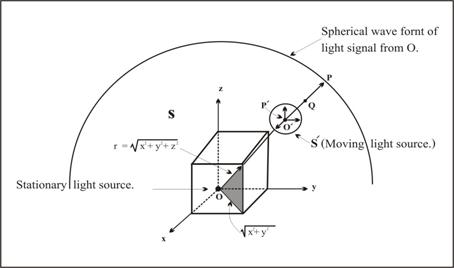
Figure 3 Vacuum medium space-time.
To see the physical
meaning of the invariance  in S defined in (9), by comparing to
  of (10) in S’, we would found that
 .
.
Someone may say that it
is just the concept of STR that “the constancy of speed of light referenced to
any moving initial observers”. But when consider the above diagram carefully we
will found that, it is the emitting light signal from P’
that reaches P not from Q (the actual position of S’ at time t). So it means that the constancy of light
speed is reference to absolute vacuum medium space, not to the observer in a
moving inertial reference frame! That is, the propagation time of light
signal from P’ to P is t’, not the time from the present position Q (of S’) to
P. Then
there is no “true” time dilation and no “true“ length
contraction!
Finally if there is no real
time dilation and no real length contraction, are proper time and proper
length still necessary? The answer is yes; because both of them are relative values
and still useful for some propose such as Doppler Effect. Beside that we still
have the relativistic clock instead of the conventional time dilation. And
for length
contraction, because it is only a relative length,
so we must be careful not to use the length contraction for guiding to the increasing density of mass!
By the way, proper
quantity was defined as the intrinsic
quantity when measuring was done by an observer on his own reference frame.
But according to STR & GTR, all reference frames are moving relative to
each other. So we could not find any “true” intrinsic
quantities in our universe. Instead
according to vacuum medium space-time, we could preserve the meaning of “intrinsic quantity”
because it is only the same one true invariance measured quantity in any
reference frame!
4) Physical meaning of space-time
curvature. According to GTR, our
universe was built with four-dimension space-time (three spaces plus one time),
but it is impossible to visualize how curve space-time is. Let’s refer to a famous professor in physics nowadays,
Stephen W. Hawking word [5] “It is
impossible to imagine a four dimensional space.” Or (again) referenced to
Richard P. Feynman word [6] “We live in three-dimension space and we are going
to consider the idea that three-dimension space is curved ……, we can’t imagine
space being bent in any direction because our imagination isn’t good enough.
(Perhaps it’s just as well that we can’t imagine too much, so that we don’t get
too free of the real world.)” Is this word still
being true forever? Could we understand three-dimension
space being curved while we still live in the real world? For my
opinion, the answer is yes we could!
So let’s us find out together by starting with a
two-dimension space below.
4.1) A new view of
curved surface.
All of us are familiar with a two-dimension curved surface
such as a portion of elastic spherical surface sheet of a basket ball shown in fig.4
(a) below. After we
flatten it out by making an appropriate cut where necessary, then what we got
is an incomplete flat sheet as shown in (b). Next, we complete the
cut-off parts by pulling the neighboring parts together (while keeping the sheet’s
thickness to be the same everywhere). Then what we got is a completed flatten
surface sheet as in (c). Actually, we could get the flattened sheet (c) just
by pressing the curved surface sheet (a). Note
that the flattened surface sheet (c) is not the same thing as a true (ordinary)
flat surface in (d) (which made
from the same elastic material)! But, what is the difference?
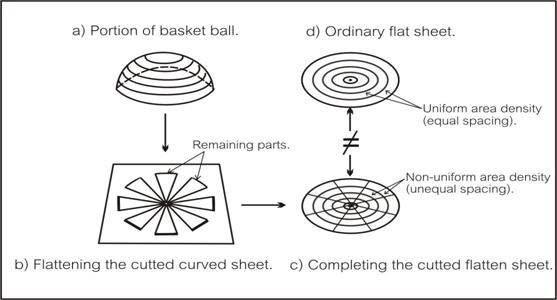
Figure 4 Comparing a curve surface with
a flat surface.
The difference is that the area density
of elastic material is uniform in a true flat surface sheet (d), while it
is not uniform in the flattened surface sheet (c) that is the area density vary from high
density around the center to the lower density at the rim of the sheet. So the
uniformity of material density of (physical) space is the crucial points
for considering whether it is a flat sheet or a curved sheet. Then from this point of view we may say that a curved surface sheet is
a non-uniform of material density of a flat surface sheet!
4.2) A better view of curved space-time. Now we will extend the concept “non-uniformity of the material
density in space” from a two-dimension curved space (curve of sheet space) to
a three-dimension curve space (curve of volume space). First we start with a simple analogy of the atmosphere which covers the surface of our
earth. We know that air density is higher near the earth’s surface and
decreasing to a lower density when the altitude is increasing. This non-uniform density of air was caused by the earth’s gravity which
is higher near the
earth’s surface and decreasing at a higher altitude. So we could say that the atmosphere space (physical space of air) is
curved. But suppose that if the gravitational attraction of the earth to
the atmosphere is the same at any altitude, then the air’s density will be uniform. In
this case we could say that the (three- dimension) atmosphere space is
flat! (Note, both the words “curve” and “flat” used
for volume space came from curve and flat sheet that we are familiar, so it may
leads to some confusion, doesn’t it?)
Up to now we have found that it is
easy to visualize and understand “flat and curved space” by using concept “uniformity
of density of the material that constitute the physical space”. So for vacuum medium space, it is the uniformity density
of vacuum medium energy that was used for considering the curvature. But we have to be careful because there are two part of vacuum medium energy. The main part is the energy that constitutes and maintains the isotopic fabric structure of space
(flat space). While the additional part is the internal stress energy in vacuum
medium that occurred due to the existing of the near by mass (gravitational
potential energy). To visualize the internal stress energy
occurred in vacuum medium, it is easy to look at “internal stress created
in incompressible fluid such as water when it
(the water) was subjected to
external force. In this
condition we would found that volume of the water is not change (mass or energy
density is the same as in the water without subjection to external force), but
there is an additional stress energy occurred in the water!
To show
formally how the concept of “non-uniformity
of energy density of vacuum medium space” could explain “curved
space”, we will go back to the two
last paragraphs in section 2.2. There, we have said that gravitational force is
the manifest of internal stress in vacuum medium space near the center of earth’s mass. While the stress in vacuum medium that closed
to the mass is higher due to the stronger force of gravity, the far away part
will be lesser due to the weaker gravity according to equation (7), that is .
.
Actually we could view
the surrounding vacuum medium as infinite numbers of unseen spherical concentric
shells with different constant value of stress in vacuum medium around the center mass. In this way, each shell would represent
different value of some constant “Gaussian surface curvature”. Also each
shell represents different
layer of “Geodesic
closed surface”.
The closer layer of the shells to the mass means the larger curvature of the
Geodesic path, while the
far away shells mean the smaller curvature of the Geodesic path.
Below are the diagrams
which show the deviation of light ray path through curve space-time. In a) the
bending of light ray path follow the imaginary curve
space of rubber sheet, while in b) the bending of light ray path follow
the Geodesic path of the Gaussian surface curvature. So we could see that it is more rational
for curved space-time with non-uniformity of the internal stress created in vacuum medium space, rather than
the conventional curved space-time of empty space!

Figure 5 Light ray path through curve space-time.
For an example, we will show how the concept
of “uniformity of the internal stress in vacuum medium space” could explain
“curved space” in GTR by using Schwarzschild exterior solution below.
 …. (11).
It is the metric
equation of line element (square of interval) of curve space-time
surrounding a spherical body mass M. And we can approximately express it in rectangular coordinate (and may be called isotopic) [7] as
below
 ….. (12).
When there is no
gravitating body (M = 0) equation (11) and (12) reduce to a flat
space-time as below
 ….. (13),
 …. (14).
Now consider the
coefficient of time component of (11) which is equal to
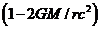 . And we could
see from (2) that the gravitational potential
. And we could
see from (2) that the gravitational potential , so
, so  [8]. When we compare in (11) with in (12) which is a flat space-time then we would see that the additional term
  is the additional energy aroused from the
gravitational potential due to M. Also this
additional energy is greater near mass M, and it will be reduce to zero when r
is infinite. Based on Vacuum medium space-time we could equally say that
internal stress energy in vacuum medium is greater near mass M, while it will
be reduce to zero when r is infinite. Or we could say that the non-uniform
of internal stress energy in vacuum medium mean the curvature in space around
mass M!
is the additional energy aroused from the
gravitational potential due to M. Also this
additional energy is greater near mass M, and it will be reduce to zero when r
is infinite. Based on Vacuum medium space-time we could equally say that
internal stress energy in vacuum medium is greater near mass M, while it will
be reduce to zero when r is infinite. Or we could say that the non-uniform
of internal stress energy in vacuum medium mean the curvature in space around
mass M!
In conclusion we could say that
a three-dimension flat space-time is the space with uniform internal stress of vacuum
medium in that space, while a three-dimension curved space-time is the space
with non-uniform internal stress of vacuum medium in that space! This is an understandable space-time, isn’t
it?
5) Modification of GTR. Up to now we have seen how the concept of vacuum mechanics (mechanism
of vacuum medium) gives a better view of gravity, relativity and space-time. It
let us to visualize and understand the mechanism of gravity, it gave us a more
natural concept of space-time and it let us understand clearly what the curved
space-time is. And because those things which we just mentioned are the
essential part of GTR, so if we want a complete GTR we have to improvement it
by using this new better concept.
5.1) Einstein tensor is vacuum tensor. Let’s look again at Einstein field
equation (3) below
 … (3).
The formula said that
Einstein tensor  is curvature tensor
 , which provides
a complete description of space-time curvature. And it is equal to energy-momentum tensor
, which provides
a complete description of space-time curvature. And it is equal to energy-momentum tensor  of all matters and energy involved (except the gravitational energy
created by the matters itself) in
the system. But there is no way to deduce the connection (between the
two parts) from more fundamental principle [9]!
of all matters and energy involved (except the gravitational energy
created by the matters itself) in
the system. But there is no way to deduce the connection (between the
two parts) from more fundamental principle [9]!
When considering it in
detail, the above space-time geometry
is a geometry of “nothing” that is; it
is the geometry of an empty vacuum space. So it is difficult to visualize how to deal with the tensor of
“nothing” which is unphysical. In the real world we normally use tensor for
solving the problem with something which is physical such as electromagnetic
field, fluid or solid materials. It is
Einstein’s genius that he could imagine (guided by Mach’s principle and the principle of equivalence)
how to link an energy-momentum tensor (physical tensor) to
describe the abstract geometry of space-time!
But
when we consider the energy-momentum tensor in the
view of the whole universe, we would found that it consists of all the matter
and energy that irregularly distributed across the universe; it is not a continuous physical medium which
contains all the necessary information for Einstein tensor. So he had
designated a new kind of material field with mass, energy and momentum
densities at each point in the system; that is the energy-momentum tensor
required.
Now we have learned above that
actually space-time geometry is the physical geometry of vacuum medium. And
this vacuum medium is the main part of mass (energy) that pervaded across the
huge universe. Then all the observable matters of galaxies, stars, dust clouds
etc. are the minor part that are immerged in the sea (of uniform distribution)
of vacuum medium through out the whole universe. Then Einstein tensor which
originally was an imaginary becomes a real tensor of physical geometry of
space-time. So we could say that Einstein
tensor is vacuum medium tensor (tensor
of vacuum medium space)!
5.2) Return of cosmological constant. Someone who familiar with GTR would
found that the total
matter and energy existed in the form of energy-momentum tensor, which is
the source that create the curvature of space-time does not include gravitational energy (which created form the total matter
and energy) itself. So it means
that the total energy in the system is not conserved! This is the crucial weak point of GTR.
And to solve the
problem, it was proposed
a quantity which play the same role as a gravitational potential; a 4x4
pseudotensor  (the
gravitational potential energy of the field) by adding it to, to assure the energy
and momentum to be conserved. How ever is merely
a pseudo-tensor, it does not have a convincing physical
presence or absence [10].
(the
gravitational potential energy of the field) by adding it to, to assure the energy
and momentum to be conserved. How ever is merely
a pseudo-tensor, it does not have a convincing physical
presence or absence [10].
Armed with vacuum medium space,
it is easy to solve the problem. We start with general form of the full field
equation with cosmological constant  as (15) follow.
 …. (15),
  ….
(16).
….
(16).
Then after rearranging
(15) and write out the 00-component as show in (16), where was replaced by
 (
( = mass density). So reference to (16), functions as a constant mass density of
vacuum medium energy, and acting as the
“ambient mass” which spread through out space [10’]!
= mass density). So reference to (16), functions as a constant mass density of
vacuum medium energy, and acting as the
“ambient mass” which spread through out space [10’]!
Einstein first introduced to act as a repulsive force in the
field equation to counter the gravity for a static universe. But after knowing
that actually the universe is undergoing an expanding, he discarded it while
said that “… the biggest mistake I ever made”. Nowadays it is assumed to be
‘very small’ so it will be still including in most treatment of relativistic
cosmology [11]. Anyway even the universe was found to continue expanding, but what
is the cause which made it to expand against the gravity? Here the author proposes to use as the ambient mass of vacuum medium energy
which is the energy source for repulsive
force mentioned.
In VMTE, we have said that the ambient
mass of vacuum medium energy is so dilute. So it is insignificant on a
planetary or local galactic scale, but it will be dominant on the cosmic
scale (because the huge volume of the universe). As for an example, we
could see it from
Schwarzschild
exterior solution derived including [7’] as below
 …. (17).
Comparing (11) and
(17) we could see that the effect of term on the field surrounding the central
mass M would increase with the size of the region considered. Hence, since the
motion of the planets are actually given with great accuracy by (11), we can
conclude that is in any case small enough not to produce
appreciable effects within a region of the order of size of the solar system. And we can calculate its value by setting  term in (16) equal to mass density of vacuum medium
  (from the last paragraph of section 6.1). Then
what we got is
(from the last paragraph of section 6.1). Then
what we got is  which is very small indeed!
Finally we have
solved the problem and fulfill the field equation (3) by just add vacuum
medium to energy-momentum tensor in term of. Actually the final result is just the
returning back to equation (15). What we have done is to give the
appropriate meaning of. Or we equally say that equation (15) is
not just a more general field equation, but it is more rational than (3). And
this is what we say that it is the returning of the cosmological term!
6)
Solution to the crucial problems in GTR. Let’s
start with a famous physicist S. Chandrasekhar (1980) word (when he had talk
about problems in GTR) as “The element of controversy and doubt, that have
continued to shroud the general theory of relativity to this day, derived
precisely from this fact, namely that in the formulation of his theory Einstein
incorporates aesthetic criteria; and every critic feels that he is entitled to
his own differing aesthetic and philosophic criteria. Let
me simply say that I do not share these doubt; and I shall leave it at that”
[12]. In this paper the author doesn’t dare to do some thing like
that, the only aim is to complete GTR. Then this will make GTR to
consistence with QMT and paving the way to the theory of everything as
mentioned in the original paper!
6.1) Problem with speed of gravity wave. Einstein had showed that the existence of
gravitational wave radiation is a natural consequence of the GTR. By
considering the case of weak field equation (space-time curvature is small), he
got a linear wave equation (of gravity) which is transverse wave traveling with
velocity of light resemble to electromagnetic wave.
But,
why gravity wave traveling with speed of light, it is just his guessed that it
would be the same speed [13].
For electromagnetic wave it is obvious that we could prove that it traveling
with velocity of light by using Maxwell equations, while we could not do the
same thing with gravity wave! This may be the reason that most of the text
books about GTR tried to avoid talking about it.
According to GTR, we known
that space-time is just an empty space
without any physical entity so it is very difficult and even impossible to
explain how gravity wave could propagate without some thing act as the medium.
(Indeed there is no exception for every kind of waves, and in CEMT we have shown
that it is unreasonable for electromagnetic wave traveling without vacuum
medium.) Some author such as I.R. KENYON [8’] who has an insight; he tried to
explain gravity waves via stress-strain relation of space-time. He said that “gravitational
waves are quite simply the vibration of space-time itself”. Unfortunately
we could not easily to visualize how space-time (which is just an empty space)
could act as the mechanism of wave!
Instead if we accept the
vacuum medium concept then it is easy to understand that gravity wave is
just the vibration (mechanism) of vacuum medium which is the same thing as
electromagnetic wave. Of course we must not expect to get everything for
gravity the same thing we do with electromagnetism. This is obvious because the
source of gravity is different from one of electromagnetism; that is normal
masses could not create all phenomena as electrons do!
Now let us explore some more detail for gravity wave by using the same concept
as of electromagnetic wave
 …… (1),
 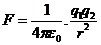 …….. (13).
By
considering equation (1) for gravity and (13) for electrostatic, we would found
that both are the result of the same attraction force arisen in vacuum
medium between two pieces of mass. The only difference between them is that
while the first one is a weaker force (normal gravity) due to the neutral
masses, the second is stronger force (black hole force) due to charged masses. So
both of the two constants G and are the
same property i.e. the internal stress of vacuum medium!
are the
same property i.e. the internal stress of vacuum medium!
Next, how could we find magnetic field for gravity which was called gravitomagnetic
field [14] or cogravitational field [15]? We know that the flowing
of electric current create magnetic field around the carrier wire, but how could
we find mass current to create gravitomagnetic field? Actually we know that
a single moving electron also create magnetic field. (Note that when an
electron is moving, it will rotate and drag surrounding vacuum medium creating
magnetic field as explained in CMET.) Then a rotating (moving or not) sphere
of mass should also create gravitomagnetic field!
And
show below is the formula for cogravitational field K (mentioned above) which
was generated from a rotating sphere of mass moving with constant speed [11’],
 ….. (14), where
 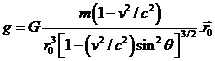 ….. (15).
While K in
(14) corresponds to in B (16) and g in (15) corresponds to E
in (17) for a point charge moving with constant speed as below
 ….. (16), where
 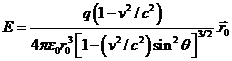 ….. (17).
By comparing (15) and (17), what we got is that G correspond to or .
.
Nowadays physicists try to find earth gravitomagnetic field according to
reference [10].They explained that gravitomagnetic field is the manifest of the
dragged of (empty) space around the rotating mass and proportional to its
angular momentum. But it is difficult to visualize how the empty space could
be dragged! So it is more reasonable for the concept of vacuum medium, and
for the author opinion, magnetic field is the same thing as gravitomagnetic
field. So the main part of earth magnetic field is the gravitomagnetic field
as mentioned in original article [1].
Finally
we will try to find mass density of vacuum medium energy as mentioned in section 5.2. Referenced to
the formula (m) in the derivation of Maxwell equation of CEMT, this was rewrite
as equation (18) below,
 …… (18).
  …… (19).
(Where c is the velocity of
light, M (elasticity) = ¼k (twist modulus),  = mass density,
 = permeability and = permittivity of vacuum medium.)
Replacing M
with k/4 and,in term of G in (18) what we got is
(19). Then comparing the second and third terms of (19) we will get
 which is mass density of vacuum medium energy! Also we could found
from (19) that the twist (shear) modulus of vacuum medium is
which is mass density of vacuum medium energy! Also we could found
from (19) that the twist (shear) modulus of vacuum medium is  which is very low!
6.2) Some other remaining problems. There are many problems involved with GTR and below are some of
the well known problems which could be solved using vacuum mechanics
concept!
a)
Missing masses and dark matter problem. One of the obvious problems about the rotating
galaxies is their missing mass which was calculated from their rotating speed. Also there is missing mass for forming of
galaxies into cluster of galaxies]. It was calculated that the missing mass
is 10 – 100 times the total amount of visible matter in the galaxies [16.
This missing mass was though to be the invisible dark matter, but no one knows
what it is. Armed with the concept of vacuum medium, it is easy to see that vacuum
medium energy is the missing mass! And when we compare them in term of mass
density, it is the ratio >20:1 (see the last paragraph of section 7.1).
b) Mysterious magnetic field in galaxies. Magnetic field with strengths of  is widespread in the cosmos – in galaxies
extended radio sources an in cluster of galaxies [17]. And according to the
reference; “most of the cosmological models have been devoted to explain
the amplification of an initial seed field by dynamo action in spiral galaxies.
Also our understanding of magnetic field in spiral galaxies is very limited”.
is widespread in the cosmos – in galaxies
extended radio sources an in cluster of galaxies [17]. And according to the
reference; “most of the cosmological models have been devoted to explain
the amplification of an initial seed field by dynamo action in spiral galaxies.
Also our understanding of magnetic field in spiral galaxies is very limited”.
“ An observation which we
believed is highly significant is that for many nearby spiral galaxies the
measured interstellar magnetic fields falls off much more slowly with radius
than the matter density, i.e. in the outer parts of such galaxies the magnetic
stress become comparable to gravity. Not only is this hard to understand in
theoretical modeling, but it is taking place at distances where the rotation
curve is flat and the flatness is usually interpreted as evidence for the
presence of a halo of dark matter”.
The above paragraph
has explained the magnetic field pattern that occurred in the rotation spiral
galaxies, but we still could not understand why it is some thing like that.
Armed with the concept
of vacuum mechanics, it is easy to see that this is the appearance of the
rotational stress of vacuum medium around the rotation of spiral galaxies! The reason is as mentioned in the above section that a big
rotating mass will drags the surrounding vacuum medium with it. And the rotational stress occurred in vacuum medium
around is the manifest of the created magnetic
field!
c) Reinterpret
equivalence principle. In
STR, Einstein used principle of relativity as the main tool,
which state that “physics in a uniform moving inertial frame is the same as
physics in a rest one”. This is possible if space-time is an empty one, because
any reference frame has an equal footing. But in CSTR, based on the
existence of the privileged reference frame of vacuum medium space-time,
this is no longer possible! So we have to reinterpret the principle of
relativity as “physics is equivalent referenced to the privileged reference
frame of vacuum medium”. In the same way Einstein has used principle of
equivalence in GTR as the main tool, and which state that physics in a uniform
acceleration frame is the same as physics in a free falling (in a uniform
gravitation field) frame. So we have to reinterpret the principle of
equivalence as “physics is equivalent referenced to the privileged reference
frame of vacuum medium”!
d) Gravitation time
delay. We know that in STR there is no explanation
why a moving observer has a time dilation. And in the first section we have
explained that actually the conventional time dilation is just the slowing
of the measuring clock (due to the slowing of the moving clock mechanism).
For GTR there is also no explanation why an observer in a stronger
gravitational field has a time dilation (compare to observer in a weaker
gravitational field or no gravitational field). Based on the concept of
internal stress in vacuum medium (as explained in section4.2), it is easy
to explain why time dilation occur!
A measuring clock will
run slower in stronger gravitational field (internal stress energy in vacuum
medium) than the weaker one. This is because the bigger resistance of
gravitational field energy, the more slows down the mechanism of the clock (compare
to one in weaker gravitational field or no gravitational field). This is a rational
and understandable explanation of what was called “time dilation”!
7) Vacuum medium universe – a better view
of our universe. The most interesting application of
Einstein field equation (3) is that it was used to describe our universe; the
story of cosmology. There are several weak points about the assumption for
developing model of the universe and also the problem about the model itself.
In section 5.1 we have shown that Vacuum tensor is a better view for Einstein
tensor. Here we will show that Vacuum medium universe (the universe
composes with vacuum medium) is a better view of the universe.
7.1) Fulfilling the cosmological
principle. While the relativity principle was the
foundation of STR and the equivalence principle provide the physical basic for
GTR, in cosmology cosmological principle was introduced to let the field
equation manageable. Note that the first two principles were modified to
get a more rational meaning under the concept of vacuum medium; now this new concept
would give the third principle to be a more meaningful. Let’s start with
the amended and presently accepted form of the cosmological principle [10’] which
state that:
“The general overall
features of the universe are the same relative to any local observer at
corresponding epochs in the evolution of the universe”.
What does it means for
the principle is to take all the existing matters (galaxies and stars)
uniformly distributed across the universe. But we know that actually the
matters are irregularly distributed, so how could we improve this weak point?
Armed with the existing of vacuum medium, the principle could be strengthening.
The reason is because the total mass of vacuum medium energy (which uniformly
distributed) is much more than that of the visible existing matters! And
when we compare them in term of mass density, it is the ratio >20:1 (see the
last paragraph of section 7.4). So it doesn’t matter how the tiny part of
visible matters was distributed; the total masses distribution in the
universe is still uniform!
7.2) What is a hypersphere?
Under the cosmological principle, a simple model of the universe was tried to
develop. A positive (spatial) three- dimensional curve surface called
“hypersurface” which is embedded in a (spatial) four- dimensional
“hypersphere” was introduced to be a model of the universe. To grasp
it intuitively it was suggested looking at an analogy of the two-dimensional
curve surface of our ordinary three-dimensional sphere balloon as the model of
the universe. Anyway it is very difficult for anyone to visualize such an extra
spatial dimension surface of the balloon as our universe, and then a question
arises immediately: is it any other simple view of the universe which we
could understand it? Indeed the answer is yes, because the concept of vacuum
mechanics helps us as below.
First let us come back
to see what actually the universe is: basically the universe is composing of
everything that existing i.e. galaxies, stars, dust and gas cloud. All of
these matters are interacting to each other by gravitational force; while the
galaxies are flying apart from each other after originate from a single common
point. From this point of view, the universe will look like a simple
expanding sphere ball (not just only the ball’s surface)! So we can use Newton gravitation law to develop
the universe [17’]. And indeed it was derived the Friemann model of the
universe by using Newton gravitation law in Newtonian cosmology [11’].
Now the question is, why
does a simple expanding sphere ball turn to be a four- dimensional (not
include time) hypersphere when it was involved GTR (which is just a
relativistic gravitational)? To answer this question, we refer to Roberson –
Walker metric equation which was derived from the concept of “four- dimensional
hypersphere” below
 ………. (20).
(Where R
is the radius of the hypersphere, k = 1, 0 or -1 according to three models;
closed, flat and open respectively.) Then we will compare it to the metric
equation of “Einstein static universe” model, which was derived from the
spherically symmetrical static form of conventional space-time geometry
[aw’’] as below
 …… (21).
Here we can see that when the term  in equation
(20) was ignored, then (20) is the same pattern as (21)! Indeed in the
reverse, equation (21) can be changed to the form of three-dimensional
spherical surface which embedded in the four-dimensional Euclidean space (as
shown in the reference); that is the starting point of Roberson – Walker metric
equation. In conclusion we could see that actually “the four-
dimensional hypersphere” is just an ordinary four-dimension space-time sphere
ball of vacuum medium in which all the visible existing matters was immerged
inside; and this is our understandable universe!
in equation
(20) was ignored, then (20) is the same pattern as (21)! Indeed in the
reverse, equation (21) can be changed to the form of three-dimensional
spherical surface which embedded in the four-dimensional Euclidean space (as
shown in the reference); that is the starting point of Roberson – Walker metric
equation. In conclusion we could see that actually “the four-
dimensional hypersphere” is just an ordinary four-dimension space-time sphere
ball of vacuum medium in which all the visible existing matters was immerged
inside; and this is our understandable universe!
7.3) The origin of universe. Nowadays, main part of cosmologists believes in the hot big
bang with inflation universe. “But the universe is the ultimate free lunch”,
this is Stephen W. Hawking’s word [5’]. The mentioned universe was suggested to
start out from the hot infinite dense singularity; then it had expanded with
acceleration (inflation) up to the present universe. The big problem is that
where did the huge quantity of the increasing matter come from, it contradicts
to Law of conservation of energy (mass)! To solve the problem, team of
experts in astronomy & astrophysics has proposed a new cosmological model
called “quasi-steady-state model” [17’].
According to the
new theory “quasi-steady-state model”, the major development is that matter
creation occurs with energy conservation. Their thesis that matter is
created and ejected in the form of quasi-stellar objects and matter in other
forms from the nuclei of galaxies are the observational evidences. In summary
the general equation of the theory was derived from the
friedmann-Robertson-Walker model by introducing a scalar field C. The
role of C - field is to act as a negative energy and negative pressure for the
effect of matter creation, and the matter creation is to accelerate the
expansion of the universe. So there is no need a hot big bang with inflation
scenario!
By the way in this new model, it
was explained that the existence of near – black hole in the center of
galaxies is an indication of the creation events have taken place. And
to visualize such events in physical terms, the suggestion conceptual
explanation is from the basic fabric of space-time. They are well-used to
thinking that particles creation occur in association with a transition that involves
space-time in a physical way, not just as a passive medium in which particles
are supposed to exist. In graphic language, particle creation would be
associated with an opening-up of space-time!
For Vacuum medium space-time, we have mentioned early that the fabric
structure of space-time was created out of vacuum medium energy. Or we could
say that vacuum medium is the raw material for constructing the fabric
structure of space-time! This means that at the starting moment, the universe is
zero size (no
space-time)
there is no vacuum
medium either.
When
the universe is expanding its size, vacuum medium must be increased for expanding the fabric structure of space-time. And
when the universe is reducing its size, it means that vacuum medium is decreasing. Then
we could see that vacuum
medium universe is possible without hot big
bang and inflation universe!
Note that actually
vacuum medium is just the contraction (gravity) energy that try to encounter
its expanding (please see detail in CEMT). So if we think that the existing
of vacuum medium as positive energy, and its intrinsic property (gravity) acts as
negative energy, then the total energy of the universe is conserved!
Finally we could see that vacuum
medium universe and quasi-steady-state
model may be classified
in the same group. Both of them were created without
hot big bang and inflation! In technical detail, vacuum medium energy
in vacuum medium universe could be though as C-field in quasi-steady-state model. And in vacuum medium universe vacuum medium energy
create space-time, while in quasi-steady-state model, particle
creation would be associated with an opening-up of space-time. So in the
future when we combine both models together, we may get a more complete
theory of our universe!
7.4) Our universe is closed! According to the hypersurface model of the universe, it was
divided to three types of space-time’s curvature depend on the value of k in
Roberson – Walker metric equation (20). First where k = 1, it represents
closed universe or the universe with positive curvature (something look
like the earth surface), second where k = 0, this will represent flat
universe or the universe with zero curvature (something look like ordinary
flat surface) and third where k = -1, it represents open universe or the
universe with negative curvature (something look like saddle shape surface).
For the first type of the universe, we have commented that it is very difficult
to visualize how it is in the real world. Also we would found that the
remaining two types facing the same difficulty!
Based on the
concept of sphere ball of vacuum medium universe, it is easy to understand all
three types of space-time curvature. As mentioned early that vacuum medium is
uniform everywhere across the whole universe. This doesn’t mean that it make
the universe flat. The reason is because vacuum medium is just act as the
background fabric structure of space-time (i.e. the ambient mass
mentioned in section 6.1) which will handle the internal stress
energy (gravitational potential energy) occurred within! So when we talking about the mass
density of the universe we mean the total energy which equal to
the ambient mass plus the conventional mass (i.e. all the existing masses we
are familiar)!
According to the
diagram shown below when the universe is close (where k = 1). It means that
the average mass density is higher near the center and lower in the area far
away, and it was shown by the spacing between the concentric rings
(actually they are concentric shells). The closer spacing means the higher mass
density while the wider spacing means the lower density. Next when the universe
is flat (where k = 0), its means that average mass density is uniform
through out the whole universe. Lastly when the universe is open (where k =
-1), this means that the average mass density is higher near the rim and
lower when approaching the center. So now we could see that it is easy to visualize
whether the universe is curved or not by using the new concept; that is the uniformity
of mass density is the indicator of space curvature!
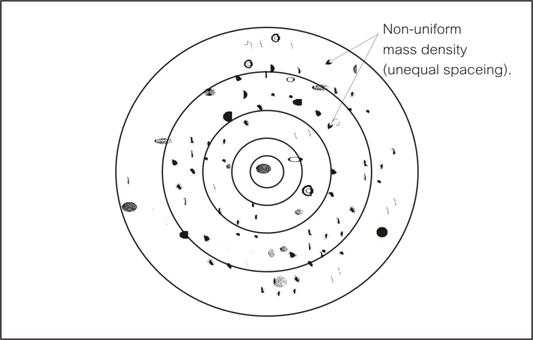
Figure 6 Curvature of Vacuum medium universe.
Now we come to the
most popular question; whether our universe
is close or open? Does it will expand forever, or at a certain time it will
collapse back to the beginning again? Up to now,
cosmologists found that the universe seems to expand to the cold dead end
rather than contract back to the hot big crunch singularity! This is
because the observed existing mass density was found
to be around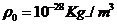 . This is far from the critical density of
mass
. This is far from the critical density of
mass  [10’’] which was needed to close the universe. (Note
  means closed universe,
  means flat universe and
  means open universe.)
Anyway, the calculated critical mass density above was made on
the assumption of zero value of cosmological constant. Here we will
recalculate by including the cosmological constant that was found in
section 5.2 above by using formula (22) [8’’] below
 . …. (22).
(Where H is Hubble constant.)
. …. (22).
(Where H is Hubble constant.)
After calculation what we got is the new calculated value of
critical mass density (A) . And from the end part of section 6.1 we
found that the mass density of vacuum medium , which is the unseen ambient mass of
space-time. When it was included with the observable existing mass densityplus its equal amount of gravitational
potential energy within itself, then we will get a new existing mass
density (B)
. And from the end part of section 6.1 we
found that the mass density of vacuum medium , which is the unseen ambient mass of
space-time. When it was included with the observable existing mass densityplus its equal amount of gravitational
potential energy within itself, then we will get a new existing mass
density (B) .
.
Now we could see that,
based on concept of vacuum medium, the new total mass density (B) is close
to the new critical density (A). So these would give us a new possibility
that our universe is no need to be only the open universe. It may be a flat
universe or a closed universe depending on the accuracy of the parameters
involved.
And if the observable
mass density is about 30%
of the critical density () which was reported lately [10’’’], that is
about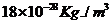 . Then we will get a new bigger value of (B),
that is
. Then we will get a new bigger value of (B),
that is . So finally we will get
 , which means that our universe is closed!
Anyway, according to
the concept of vacuum medium that space-time was created from vacuum medium
energy. Then whether the universe is flat or open, this would mean that it
will expand forever. And what will follow is the infinite amount of mass
(energy) would be created! But that is crazy, so in this sense the only
possible choice is that the closed universe, isn’t
it?
8) Conclusion. Up
to now we have seen how GTR was improved by adding
it with rational philosophical idea (which tell how the theory work); the
mechanism for relativistic mechanics i.e. the mechanism of vacuum
medium (or vacuum mechanics)! Indeed it is the same mechanism used in
improving STR and extends to cover GTR. (Note that GTR is extended from STR by
including gravity.)
The crucial things
which vacuum mechanics give to GTR are the mechanism of gravity,
physical space-time, physical meaning of curve space curvature and how gravity
wave propagates etc. All these things could not be understood in the
conventional GTR, armed with the new concept, it is easy to visualize and
explainable!